The Office of the Dean of Students hosted a Curriculum Vitae Masterclass at GIMPA Business School on 10 November 2025, where career readiness consultant Comfort Sey Yankey of CSY HR Services showed students how to write effective, competitive CVs.
The GIMPA Case Study Hub partnered with the 39 Country Initiative of Ivey Business School, Canada, to host a half-day workshop on 4 November 2025 at the Daniel McKorley Moot Court. The workshop was designed to equip faculty with skills in case-based teaching and case writing, with practical guidance on integrating the case method into teaching and learning.
Michael Danquah and Williams Ohemeng of GIMPA, with Bazoumana Ouattara and Alfred Barimah, examined how climate variability affects labour productivity across municipalities in the Accra city region, combining enterprise survey data, sub-city climate data and interviews with firms and city authorities. Rainfall, a major source of vulnerability in the city, significantly reduces labour productivity.
The African Centre of International Criminal Justice at GIMPA Law School launched the maiden edition of the African Journal of International Criminal Justice on 30 October 2025 at the Dr Daniel McKorley Moot Courtroom. The journal is intended as a platform for scholarship on international criminal law and justice issues affecting Africa.
GIMPA Law School signed a three-year memorandum of understanding with the Presidency of the Dominican Republic and the Leitner Center for International Law at Fordham University on prison reform and criminal justice. It covers joint research, training of prison and judicial officials and technical assistance, with a focus on pretrial detainees and rehabilitation and social reintegration.
GIMPA was one of eight institutions in Accra chosen for the UN in Ghana’s '8 Trees for 8 Decades’ symbolic tree planting marking the 80th anniversary of the United Nations. Deputy Rector Prof. Ebenezer Adaku represented the Institute; seedlings of fruit and indigenous species were supplied by the Forestry Commission and custodianship of the trees was assigned to host institutions.
GIMPA Training and Consulting runs a two-week Women in Management (WIM) Senior Level programme, with a cohort starting on 7 October 2025. The course is designed for women in leadership roles and aspiring managers, and aims to build a leadership foundation and the confidence to navigate leadership roles while exploring styles aligned with personal strengths and values.
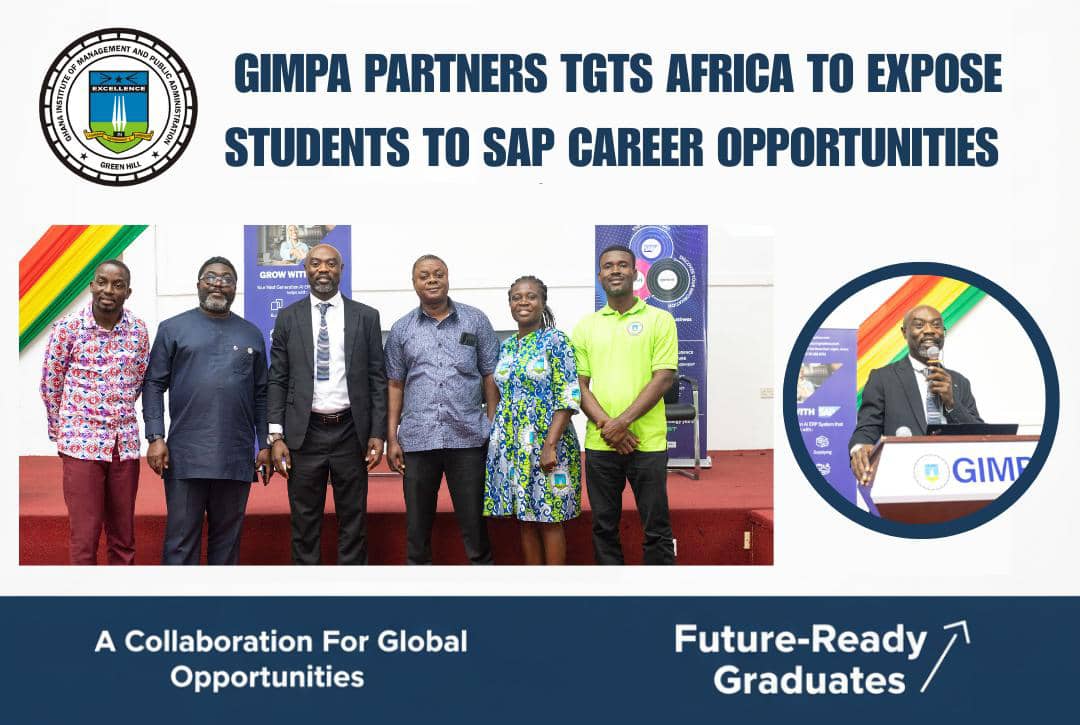
GIMPA Business School, the School of Technology and Social Sciences and the GIMPA Hub for Teaching and Learning partnered with TGTS Africa, an SAP partner in Ghana, to expose students to SAP career opportunities and facilitate free SAP training and certification. The collaboration is part of GIMPA’s agenda to align programmes with industry demand.
Raphael Aryee, Ebenezer Adaku and colleagues at GIMPA studied the role of organisational citizenship behaviour and green human resource management in circular economy practices, using data from 196 manufacturing firms in Ghana. The study is featured in the GIMPA Research Newsletter (March 2026) alongside the team’s earlier work on reverse logistics decision frameworks.
Development Impact West Africa, a partnership between GIMPA and the Center for Effective Global Action, hosted the 2025 Development Impact Summit in Accra on 26 and 27 August 2025, themed 'Advancing Evidence-Informed Policymaking for Sustainable Development in West Africa'. Presentations included the impact of Ghana’s free maternal health policy on infant and child feeding, and irrigation for smallholder farmers.
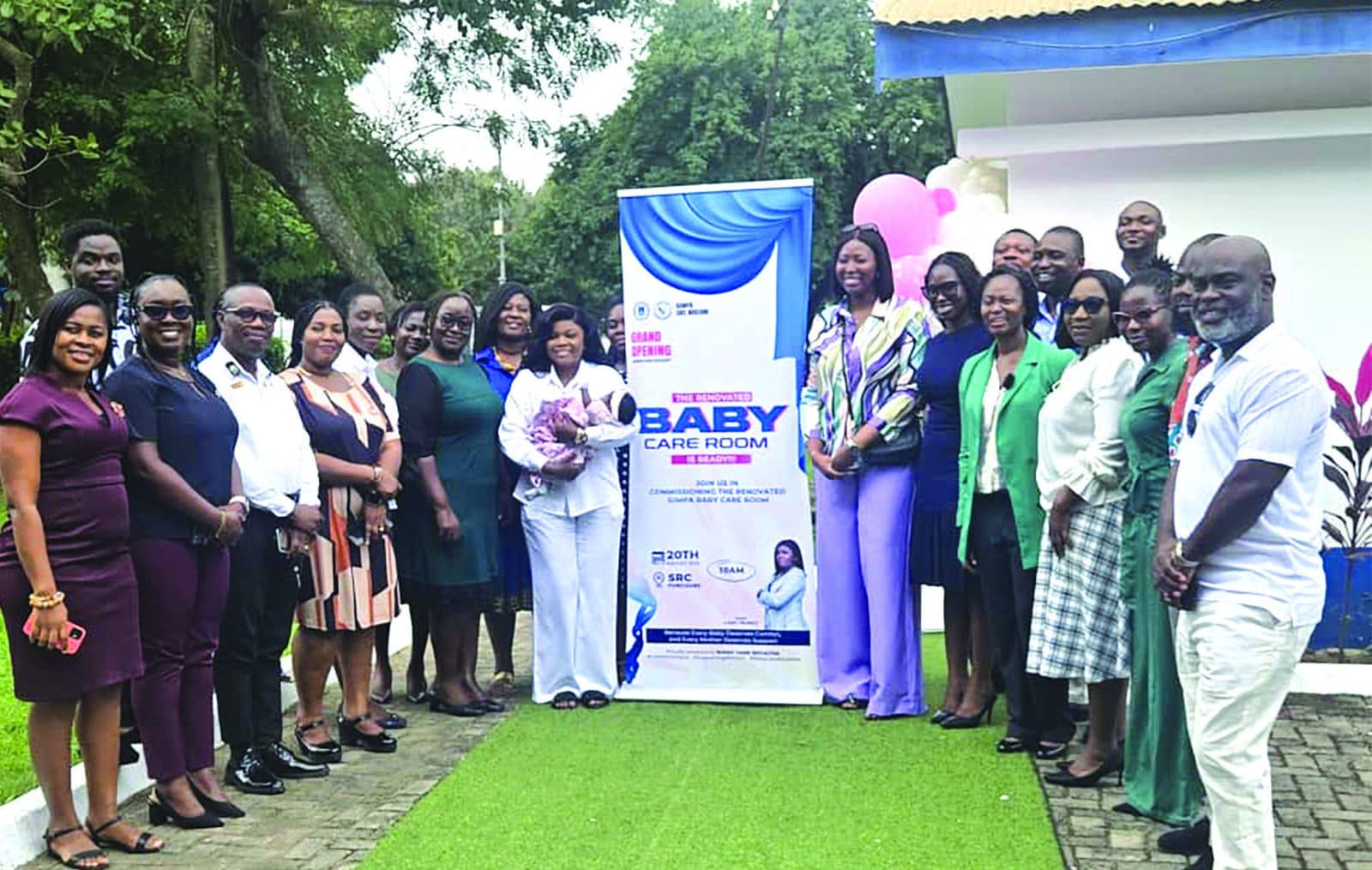
On 20 August 2025 the Students’ Representative Council commissioned a Baby Care Room at the Procurement Block to support the childcare needs of students and staff. The facility was initiated and renovated under the SRC Women’s Commissioner for 2024/2025, and the Secretary of the Institute described it as a demonstration of the SRC’s commitment to inclusivity for parents balancing study and family.
GIMPA’s Research Newsletter (March 2026) features 'Adoption Patterns and Impact of Digital Technologies Among Ghanaian Market Women' by Theresa Mannah Blankson and co-authors, using World Bank informal-sector survey data. It reports digital adoption of 68% for female-led businesses against 74% for male-led ones, with labour productivity gains of 107% for female-owned businesses that adopted.